By
By 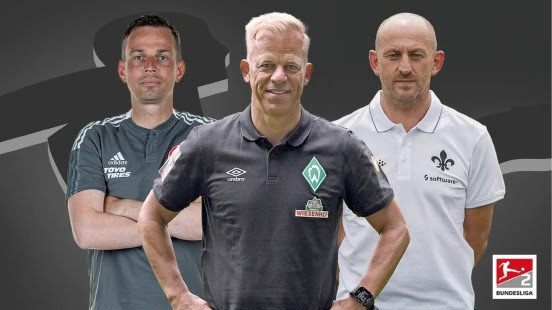
There are some huge names in Bundesliga 2 for the 2021/22 season with the likes of Schalke, Werder Bremen, Hamburg and many more all vying for a place at the top table again, but who are the people leading the teams on their mission?
We introduce the coaches who will be on the touchline in Germany’s second division…
Werder Bremen: Markus Anfang
This is only the second season Bremen have spent outside of the top flight since the Bundesliga was created in 1963, so Die Grünweißen have brought in someone who knows the league in Anfang.
The 47-year-old succeeds Florian Kohfeldt after he was dismissed with one game to go last season, and the opening match of this campaign against Hannover will be his 100th as a coach in Bundesliga 2, where he averages 1.68 points per game.
He took Holstein Kiel to the brink of promotion in 2017/18 before falling at the final hurdle in the play-off, then oversaw 31 of Cologne’s 34 games as they came up the following year. Most recently, he guided Darmstadt to seventh in the division last season. His teams tend to be high scorers, which may mean we see American striker Josh Sargent flourish under his tutelage.
Schalke: Dimitrios Grammozis
Grammozis is another coach familiar with the ins and outs of Bundesliga 2, which was why Schalke hired him as their fifth coach of last season in March when relegation already looked a certainty.
The 43-year-old has had several stints as an assistant coach at Bochum, as well as being in charge of a number of the club’s youth teams – another reason the Royal Blues picked him out for their rebuild. His only previous job as head coach in professional football was with Darmstadt from February 2019 to the end of the following season.
His record with the club in Bundesliga 2 was solid and perhaps just what Schalke want – having averaged 1.6 points from his 45 games at the helm – as they look to make this fourth stint in the second tier another brief one.
Holstein Kiel: Ole Werner
Having only turned 33 at the end of last season, Werner is the youngest coach across either of the top two divisions, while still being one of the longest-serving currently in Bundesliga 2 following his appointment in September 2019.
Prior to that, he’d worked his way through the ranks at Kiel, coaching in the youth teams, being an assistant coach for the reserves before a five-year spell in charge of that team. During that time, he also oversaw two games as caretaker boss of the first team in 2016. Werner was born not far from Kiel and played in their academy before quitting at 21.
After a year in Australia, where he worked as a gardener, he returned to Germany to study economics before getting into coaching. He guided Holstein to 11th in his first partial season, before leading them to third (ultimately losing to Cologne in the play-off) and also the DFB Cup semi-final last term.
Hamburg: Tim Walter
At 45, Walter is almost one of the elder statesmen of Bundesliga 2 and another former Kiel coach who’s found his services in demand around the league. Prior to that one-year spell at Holstein in 2018/19, he’d been lured from the Karlsruhe academy to Bayern Munich’s U17s, where he guided a team featuring Lukas Mai, Christian Früchtl and Oliver Batista-Meier to the national title in 2017.
The following year he was appointed to the club‘s reserves and took them to second in the fourth-tier Regionalliga Bayern. After a year in Kiel, he was lured to relegated VfB Stuttgart and had them on course for an immediate Bundesliga return, but was dismissed in December 2019.
And now after 18 months out, he’s back in action at Hamburg as their sixth coach following relegation from the top flight in 2018. After three straight fourth-place finishes, HSV is trying their luck once again, but Walter insists that setting a goal for the season is the “completely wrong approach”.
Fortuna Düsseldorf: Christian Preußer
In contrast to the coaches above, Düsseldorf have opted for a Bundesliga 2 novice to replace Uwe Rösler in their second season back in the division. The appointment of 37-year-old Preußer is one made with the intention of bringing through younger players.
The Berliner spent several years in charge of the academy at Rot-Weiß Erfurt, working his way up the coaching ladder to take over the first team in March 2015, having previously taken interim charge for two games in 2012 at just 29. His tenure was short and only lasted until December, after which he took over as boss of Freiburg’s reserves in 2016.
Things only went from strength to strength there, immediately earning them promotion to the fourth tier before finishes of fourth, seventh, 13th and finally first to go up to the third division, before Fortuna came calling this summer. “I couldn’t imagine a better club for my next step and am looking forward to our future work with the team,” Preußer said at his unveiling.
Karlsruhe: Christian Eichner
A former left-back with Karlsruhe, Hoffenheim, Cologne and Duisburg, Eichner retired due to injury at 33. He got into coaching back at KSC with the U17s as the assistant to MarcPatrick Meister, who took Eichner with him when promoted to the first-team job. The
Sinsheim native remained in the role under Alois Schwartz until the latter’s dismissal in February 2020, when he was named interim head coach with the team second from the bottom after 20 games. A win on the final day saw Karlsruhe leap out of the play-off spot and to safety, earning the now 38-year-old a two-year contract. In his first season in full-time charge, he guided the club that brought the world, Oliver Kahn, to sixth place.
Darmstadt: Torsten Lieberknecht
In the wake of Anfang’s departure to Bremen, Darmstadt has brought in the big guns. Only Heidenheim’s Frank Schmidt has overseen more games in the division among current Bundesliga 2 coaches than Lieberknecht’s 230.
The 47-year-old is best known for his decade in charge of Eintracht Braunschweig, where the former midfielder was first a player, then U19s coach before taking over the senior side in May 2008 and earning them what seemed an improbable place in the newly created third division.
Within three years, he’d taken the team into Bundesliga 2. After two seasons there, he guided Braunschweig back to the Bundesliga for the first time in 28 years in 2013. Their stay lasted only a year, but Lieberknecht remained with the club. They missed out on another top-flight return via the play-off in 2017, before final-day relegation the next year saw the coach and club part ways after 10 years. He took over at Duisburg a few months later but failed to guide them to safety in Bundesliga 2.
An immediate return wasn’t forthcoming after a fifth-place finish in the third division, and he was dismissed early into the 2020/21 campaign, but he is now back in Bundesliga 2 with the Lilies.
Heidenheim: Frank Schmidt
The aforementioned Schmidt is the longest-serving coach in either of the top two divisions by some considerable margin, having taken over at Heidenheim in September 2007. He’s overseen 515 games as of the end of 2020/21, of which 238 have been in Bundesliga 2 – the most by any coach at a single club.
Born in Heidenheim, he spent the last four years of his playing career at the club before working as an assistant under Dieter Märkle from the start of 2007/08. After only six games, he was named caretaker coach until the winter break, but things went so well the club extended his deal.
In his second year, the now 47-year-old took FCH into the third tier for the first time in 30 years. Five top-half finishes culminated in a maiden promotion to Bundesliga 2 in 2014, where the club has comfortably remained under Schmidt.
Their best finish was third in 2019/20, only missing out on yet another promotion after defeat on away goals in the play-off against Bremen. Schmidt was the poster boy for a 2013 film called Trainer! about three young German coaches and included insight from Jürgen Klopp. It was named the best football film on Netflix by Paste Magazine in 2017.
Paderborn: Lukas Kwasniok
Kwasniok is another former Karlsruhe youth coach now working in Bundesliga 2. After moving to the city with his family from Poland at the age of seven, he came through the academy before joining Arminia Bielefeld in the Bundesliga.
Injuries hampered his progress, though, and the one-time Germany U16s captain retired from professional football. After playing for local amateur clubs, he began coaching in the lower leagues before Karlsruhe brought him in to lead their U17s.
He was soon promoted to the U19s, and in 2016 oversaw two games as caretaker boss for the first team. After leaving KSC in summer 2018 following a failed move to Erzgebirge Aue, he was named head coach at Carl Zeiss Jena in the third division in December, before also taking on the role of sporting director in January 2019. After being dismissed in September, he took over at
Saarbrücken in the winter and guided them to the DFB Cup semi-finals – the first fourth-tier side ever to do so. After agreeing to leave at the end of 2020/21, the 40-year-old has replaced longstanding Steffen Baumgart at Paderborn for this season.
St. Pauli: Timo Schultz
Schultz, 43, is very much a part of the Pauli furniture. He made 138 appearances for the first team as a player. After signing in 2005, the central midfielder was a key member of the squad that reached the semi-finals of the DFB Cup as a third-tier side in 2005/06, won promotion to Bundesliga 2 in 2007, and then went up to the top flight in 2010.
The Hamburg club’s Bundesliga stays lasted only a year, after which Schultz became an assistant coach for the reserves while also playing for the team occasionally. In 2012/13, he became No.2 for the first team under Andre Schubert and remained in the job under three further head coaches until December 2014. After moving into the academy to oversee the U17s and then U19s, Schultz was called upon to take over the first team from Jos Luhukay for the 2020/21 campaign, guiding the cult club to 10th place.
Nuremberg: Robert Klauß
As a player, Klauß mostly played in the lower leagues as a striker, but he was part of the RB Leipzig squad for their first-ever season in 2009/10. It was there that he also began his coaching career – while still playing amateur football – when working as an assistant with the U14s and then U15s.
In 2015, he was placed in charge of the club’s U17s and won the regional league section, but lost in the national semi-finals. The now 36-year-old then took over the RBL reserves in 2016/17.
When that team was dissolved, he moved to the U19s in 2017/18 at the same time as coming top of his class in his DFB coaching course. When Ralf Rangnick took charge of the first team in 2018/19, he appointed Klauß as one of his assistants alongside now head coach Jesse Marsch, and he remained in position for the first season under Julian Nagelsmann before Nuremberg came calling and offered him the top job at Der Club for 2020/21.
Having only survived relegation from Bundesliga 2 via the play-off before his arrival, he stabilised the Bavarians with an 11th-place finish in his maiden campaign as a senior head coach.
Erzgebirge Aue: Aleksey Shpilevsky
Born in Minsk, Belarus, Shpilevsky came to Germany as a six-year-old when his father Nikolai joined Ludwigsburg in the third tier. He was a defensive midfielder in his youth days, playing in the academy at Stuttgart and representing Belarus at the 2005 UEFA European U17 Championship, but a back injury forced him to retire in 2006 at only 18.
He later began coaching at Stuttgart’s and then Leipzig’s academy before returning to Belarus in summer 2018 to take over Dynamo Brest in the first division. His stay was only short, though, due to disagreements within the club. He was back at work by November in Kazakhstan with Kairat, who he led to second place in 2019 and then the title in 2020.
This summer the 33-year-old was picked to succeed Dirk Schuster at Aue following a 12th-place finish. “After several intense discussions, we came to the conclusion that he completely identifies with the values of our club,” said president Helge Leonhardt when unveiling Shpilevsky on a three-year contract.
Hannover: Jan Zimmermann
Although a Hanover native, Zimmermann never played for H96 and began his career in the Bayer Leverkusen academy. The forward spent the majority of his playing days in the lower leagues, including with the Borussia Mönchengladbach reserves. In 2011, he joined 1. FC Germania Egestorf/Langreder as player-coach.
Although he hung up his boots after three years, he spent a total of seven at the club and guided them from the sixth up to the fourth tier, as well as qualifying for the 2016/17 DFB Cup. In 2018, he was appointed coach at former club Havelse, where he won the Lower Saxony Cup in 2020 and also earned promotion to the third division last season – the first time in 30 years the club has been at a professional level.
He’s now been brought in by Hannover as they look to rebuild with a youthful base. “His perception of football is the perfect fit for our future philosophy and strategy,” said club boss Martin Kind.
Regensburg: Mersad Selimbegovic
Born in Rogatica, Yugoslavia – now part of Bosnia and Herzegovina – Selimbegovic started his playing career in his homeland with Zepce and Zeljeznicar before a 2006 move to Regensburg. The club had just been relegated to the fourth tier, and Selimbegovic earned himself a place in central defence as Jahn bounced straight back.
Although he spent six seasons with the club, injuries limited him to only 99 appearances and he retired in 2012 as Regensburg returned to Bundesliga 2, becoming an assistant coach with the club’s reserves.
He held the post for four years, completing his coaching badges at the same time, before taking charge of the U19s for 2016/17. The first team had suffered two relegations and then two promotions in the five years since he retired, so when Achim Beierlorzer took over for their return to Bundesliga 2 in 2017, Selimbegovic was named his assistant.
And when Beierlorzer left in 2019, he was handed the top job, guiding the Bavarians to solid finishes of 12th and 14th so far.
Sandhausen: Stefan Kulovits and Gerhard Kleppinger
The set-up in Sandhausen is a little unusual as they currently have co-head coaches. Kulovits, 38, is a former Austria international midfielder who joined SVS as a player in
2019, while Kleppinger, 63, is a former Bundesliga defender with the likes of Schalke, Borussia Dortmund, Hannover and Karlsruhe, and has been coaching since 1994.
The pair were assistants under Uwe Koschinat in 2019/20 and then under Michael Schiele for three months last season before he was dismissed with the team in danger of relegation. Kulovits and Kleppinger were put in charge and guided them to safety in 15th, but because only Kleppinger held the necessary coaching licence, he was regarded as the head coach by the DFL.
The duo known as ‘Kleppo’ and ‘Kulo’ still worked equally and have now been retained in the position for 2021/22, even though Kulovits has received his UEFA A Licence over the summer.
Dynamo Dresden: Alexander Schmidt
At 52, Schmidt is among the oldest coaches in Bundesliga 2 for 2021/22. The Augsburg native, who also played for Die Fuggerstädter but never at a level above the third tier with any of his 12 clubs, has been coaching since 2000 when he started with the FCA U17s.
Two years later, he joined 1860 Munich. During his time with the academy there, he worked with future household Bundesliga names like Lars and Sven Bender, Kevin Volland and more. He would climb the ranks with the club, up through the youth teams to be assistant with the first team, head coach of the reserves and then finally boss with the senior side by 2012.
He had a brief spell in charge of Regensburg in 2014 before working as a scout at Stuttgart. In 2017, he joined the Red Bull Salzburg academy before his next senior job in charge of St. Pölten in Austria for the 2019/20 campaign. Schmidt returned to Germany for the next season with the new third division club Türkgücü Munich but was dismissed in February.
In April, he succeeded Markus Kauczinski at Dresden with six games remaining. He won five of them to see Dynamo promoted as champions and earn him a contract until 2023.
Hansa Rostock: Jens Härtel
Born in East Germany, Härtel began his playing career with Lokomotive Leipzig. After reunification, he had a total of five years, across two spells, at Union Berlin, as well as several other clubs outside of the Bundesliga.
He retired due to injury in 2005 with Germania Schöneiche, where he became head coach and got them into and remained in the fourth tier. After four years as an assistant at Babelsberg, he took over at Berliner AK – qualifying the team for the DFB Cup by winning the Berlin Cup – before he opted to work at RB Leipzig with the U19s in 2013.
That job only lasted a year before he became head coach at Magdeburg. His first season saw the club promoted to the third division and playing professional football for the first time in a reunified Germany. After two fourth place finishes and a state cup, he got the club into Bundesliga 2 for the very first time.
On the back of being dismissed in November 2018, he took over at Rostock in January 2019. Following two straight finishes of sixth, he guided Hansa to second last season to end their nine-year stay in the third division and back up to Bundesliga 2.
Ingolstadt: Roberto Pätzold
Pätzold, 42, was born in Berlin and had his first job in coaching with lower-league at Eintracht Bamberg in 2014/15, but only lasted a few months. He started working with the U19s at Ingolstadt in 2015, twice earning promotion. At the back end of 2018, he oversaw the first team for one game on an interim basis following the sacking of Alexander Nouri, before returning to the U19s.
He’s now been promoted to the top job full time for the new season, replacing Thomas Oral – who left by mutual consent – after he’d guided Die Schanzer back to Bundesliga 2 by winning the play-off against Osnabrück.