By
By 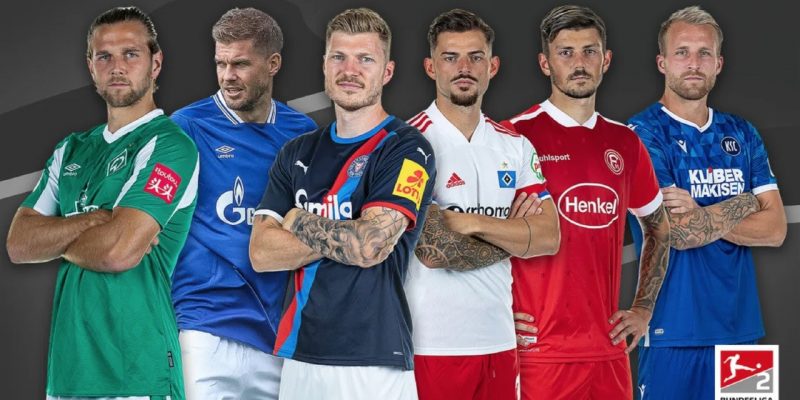
As there are no Bundesliga 2 fixtures this weekend, today marks the inaugural edition of our team spotlight, where we provide a comprehensive overview of all the teams that are participating in Bundesliga 2 during the 2021/22 season. This week, we focus on some of the biggest names in the league, including former Bundesliga champions SV Werder Bremen, FC Schalke 04, and last season’s playoff contenders Holstein Kiel.
Bundesliga 2 promises to be more competitive than ever in 2021/22. In the first of a three-part series, we profile six clubs – including Josh Sargent’s Werder Bremen and Matthew Hoppe’s Schalke – who will be battling it out in the second tier.
Werder Bremen
History
Around since 1899, Bremen finished 10th in the inaugural 1963/64 Bundesliga. Having missed just one year before 2021/22, they hold a Bundesliga record of playing 57 topflight campaigns.
They are the fourth most successful club in the German top flight, winning the Bundesliga four times since 1964/65. They are also seven-time runners-up, have claimed the DFB Cup on six occasions and also lifted the European Cup Winners’ Cup in 1991/92.
Stadium
The Wohninvest Weserstadion was completed in 1947 but has undergone several changes since, one of the most recent of which introduced solar panels on the roof. Fans can even arrive by boat at the picturesque venue holding 42,100 people, which is located on the city’s Weser river.
Biggest success
The Green-Whites beat Monaco to earn their first European silverware in 1992, and the last season they snared a trophy was a spectacular one, too. A Mesut Özil goal helped them past Bayer Leverkusen in the 2008/09 DFB Cup final, while strikes from Brazilian playmaker Diego and Peruvian club legend Claudio Pizarro helped them beat northern rivals, Hamburg, in the UEFA Cup semi-final that same year. They eventually lost after extra time to Shakhtar Donetsk in the final.
Twice a league and cup winner with Bremen as a player, Thomas Schaaf led the club to their most dramatic success in 2003/04. The Bundesliga-winning campaign included a 23-game unbeaten run, and they followed up with a 3-2 DFB Cup final victory over Alemannia Aachen. It remains the only league and cup double in Bremen’s history.
Aim this season
With American ace Josh Sargent getting two goals in a 3-2 win over Fortuna Düsseldorf on Matchday 2, bouncing back to the top flight straightaway – just as they did after their only previous relegation in 1980 – has to be the goal.
Schalke 04
History
Founded in 1904 – hence the 04 in the club crest and full name – Schalke were a dominant force during the 1930s and 40s. The seven-time German champions have never won the Bundesliga since its formation in 1963, but they have been runners-up on eight occasions.
Stadium
Schalke are one of Germany’s best-supported clubs, with derby days against local Ruhr rivals Borussia Dortmund a key date in the calendar. The Veltins-Arena has been designed to optimise the noise levels and – with a capacity of 62, 271 – there is quite a racket on matchdays. The stadium features a retractable roof and has a four-screen video cube that allows every fan to get a great view of the replays.
Biggest success
Schalke had eight top-three finishes between 2000 and 2018, and looked set to win a maiden Bundesliga title in 2000/01 only to lose out to Bayern Munich in the final seconds of the campaign.
The five-time DFB Cup winners won their last trophy in 2010/11, when a team featuring future World Cup winners Manuel Neuer and Benedikt Höwedes, Julian Draxler, Klaas-Jan Huntelaar and Spanish star Raul won the final 5-0 against Duisburg. Ralf Rangnick’s side made it to the UEFA Champions League semi-final that year as well, but their greatest achievement dates back a little further.
German goalkeeper Jens Lehmann and Belgian attacker Marc Wilmots were the heroes as the Royal Blues beat Inter Milan on penalties in the 1996/97 UEFA Cup decider.
Aim this season
Relegated for only the fourth time in their history, Schalke will want to get out of Bundesliga 2 as swiftly as possible. With second-tier promotion specialist Simon Terodde and USA international and CONCACAF Gold Cup winner Matthew Hoppe in attack, they have every chance of doing so.
Holstein Kiel
History
The club’s badge references the year 1900, a nod to one of two clubs – along with FC Holstein von 1902 – that merged in 1917 to form the current outfit. From the northern state of Schleswig-Holstein, they were German champions in 1912 but spent most of their time in the lower leagues before returning to the second tier in 2017.
Stadium
The Holstein-Stadion has space for 15,034 spectators. It was originally opened in 1911 and is one of the 20 oldest grounds in Germany. Further renovation works are planned, which would see the ground’s capacity increase to 22,000 by 2026.
Biggest success
The 1-0 win over Karslruher FV in the 1912 German championship final remains Kiel’s biggest achievement on paper, although they have accomplished plenty since then as well. In January 2021 they dumped Bayern out of the DFB Cup on penalties, although they would have traded that success for becoming the 57th team to feature in the Bundesliga. They narrowly missed out on promotion to Borussia Mönchengladbach in 1964/65, before losing playoffs against Wolfsburg and then Cologne in 2017/18 and 2020/21.
Aim this season
Back-to-back defeats in the final two matchdays cost Kiel automatic promotion last season, and after bouncing back to win 1-0 at Cologne they lost the second leg of their promotion/relegation play-off 5-1. They would love to get the chance of going up by finishing in the top three again, but that could be difficult after losing their opening two matches against St. Pauli and Schalke. If on loan Bayern striker Fiete Arp starts firing, though, things could change quickly.
Hamburg
History
Hamburg’s origins go back to 1887, with the current set-up the result of a merger in 1919. Like Nordderby rivals Bremen, they’re another hugely successful club that find themselves in the German second tier. They have been German champions six times – including three times since the Bundesliga was formed – as well as kings of Europe.
Stadium
Based in Germany’s second-biggest city, it’s no surprise that Hamburg have a sizeable backing. Sizeable enough to pack into the impressive Volksparkstadion, which has a capacity of 57,000.
Biggest success
Future Bayern, Hamburg, Schalke and Wolfsburg boss Felix Magath was the star of some of the club’s most cherished moments, delivering their first European trophy with the clinching goal in the 1976/77 Cup Winners’ Cup final against Anderlecht. Liverpool and England attacker Kevin Keegan arrived that year and would help Hamburg to their first Bundesliga title in 1978-79.
Two more league glories followed between 1981 and 1983, with imposing frontman Horst Hrubesch plundering plenty of goals for Ernst Happel’s side before serving as captain on the biggest day of all. Pipping Werder Bremen to the title in 1982/83 would have been dramatic enough, but Magath crowned the club’s epic campaign by netting the only goal in the European Cup final against Juventus in May 1983.
Aim this season
Previously the Bundesliga’ only ever-present club before their relegation in 2018, Hamburg have finished fourth in Bundesliga 2 in each of the last three seasons. A 3-1 win at Schalke got the 2021/22 campaign off to a flyer, and perhaps their experience of just how tough a division it is can give Hamburg an edge in their promotion push.
Fortuna Düsseldorf
History
The 95 in the club crest is a reference to the year 1895, when a gymnastic club was formed in the current-day Düsseldorf neighbourhood of Flingern. They rose to win a German championship in 1933 and twice lifted the DFB Cup in 1979 and 1980.
Stadium
The Merkur Spiel-Arena was completed in 2004 to replace the old Rheinstadion near the river Rhine. The ground holds 54,600 and is set to be used as a venue when Germany hosts UEFA Euro 2024.
Biggest success
The club’s best season was in 1978/79 when they experienced both the agony and ecstasy that can come with reaching a cup final. In May 1979 they went down 4-3 to Barcelona in the European Cup Winners’ Cup final, but a month later they won the DFB Cup for the first time when they beat Hertha Berlin. Both games went to extra-time and Wolfgang Seel – who scored twice against Barca – got the only goal against Hertha.
Aim this season
Having finished fifth in 2020/21 – six points off the promotion places – Düsseldorf will be aiming for the top flight. Relegated in May 2020 after a two-year stay in the Bundesliga, they have kept Wolfsburg’s Felix Klaus on a permanent deal as they look to repeat their title-winning campaign of 2017/18.
Karlsruher SC
History
Karlsruher’s history goes back to 1894, and they won their only national championship title in 1909. The club developed after a number of mergers in 1952, and they played the inaugural Bundesliga season in 1963. Two-time DFB Cup winners, they have been out of the top flight since 1998.
Stadium
The BBBank Wildpark gets its name because it was part of the former deer park of the Grand Dukes of Baden. Its current capacity is 20,740 but that will increase to 34,000 once redevelopment works are completed in 2022.
Biggest success
Karlsruher were back-to-back German Cup winners in 1955 and 1956 but their most notable campaign was in 1993/94. Part of a run of top-half finishes between 1992 and 1997, KSC matched their previous best placing from the season before by ending sixth in the Bundesliga. Added to that, though, the club earned their “Eurofighter” nickname during an incredible UEFA Cup run.
With a squad featuring current Bayern CEO Oliver Kahn, Croatian defender Slaven Bilic and future Germany stalwart Jens Nowotny, Winfried Schäfer’s team knocked out PSV Eindhoven, Valencia, Bordeaux and Boavista before losing on away goals to Austria Salzburg in the semi-finals. The most astonishing feat of the club’s centenary year came in the second round. Trailing 3-1 from the first leg, Karlsruher crushed Valencia 7-0 in the return match in November 1993. Striker Eddy Schmidt got four goals in a game that became known as the Miracle of the Wildpark.
Aim this season
Karlsruher made a dream start by scoring six goals in wins over Hansa Rostock and Darmstadt. Philipp Hoffmann netted three times in those two matches, following on from his total of 30 in the team’s first two years back in the second division. Competition for promotion is fierce, but – with Hoffmann in the team – Karlsruher can try to at least match their sixth-place finish from 2020/21.